Salesforce Stock Drops 32% in 2026: Bets and Agentforce
Salesforce stock drops 32% in 2026 ahead of Q1 FY2027 earnings. Investors eye Agentforce and the $25B buyback.
by Cleverson Gouvêa
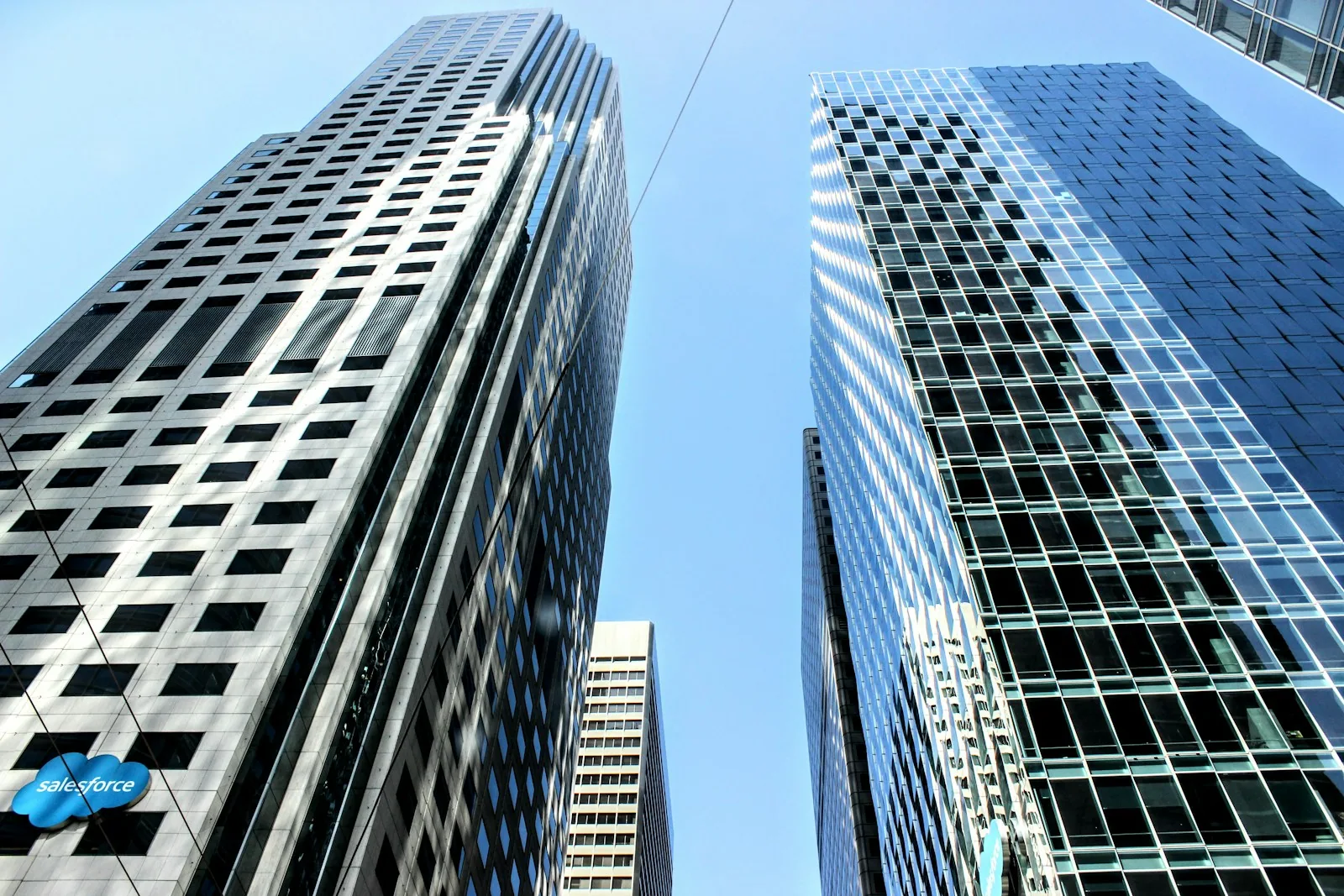
Salesforce stock drops 32% in 2026 and heads into Q1 FY2027 earnings (for the quarter ended April 30, 2026) under real pressure: the market wants to see if Agentforce is already paying off, whether the $25 billion buyback is defensive or offensive, and if the CRM giant's AI thesis can withstand competition. Here's a practical read — numbers, signals, and what to expect — for those following the sector from Brazil.
TL;DR — what matters before the May 27, 2026 release:
- Salesforce stock drops about 32% in 2026 (ticker CRM on NYSE), with shares oscillating near $180 on the eve of earnings.
- Wall Street consensus: revenue of $11.05B in Q1 FY2027 (+12.5% YoY) and adjusted EPS of $3.12 (+21% YoY).
- Agentforce ARR closed Q4 FY2026 at $800M (+169% YoY); market wants acceleration in Q1.
- $25B buyback, financed by debt in 8 tranches, is the largest repurchase program in the company's history.
- Options price a move of 8.7% in either direction after the release.
What happened to Salesforce stock in 2026
I've been following the enterprise software sector for over a decade, and what happened to Salesforce stock in 2026 is not just market noise. It's a structural repricing.
CRM started the year around $265 and touched $164 in mid-May. A drop of nearly 35% from the 52-week high — placing Salesforce among the worst performers in the Dow Jones Industrial Average for the year. The partial recovery to $180 seen in the week of earnings was more of a technical bounce than a narrative shift.
The pain doesn't come from poor operational performance. Salesforce closed fiscal 2026 with $11.2 billion in Q4 revenue (+12% YoY) and $14.4B in free cash flow for the year, with an FCF margin of 34.7%. That's operational excellence. However, the market doesn't pay a premium software multiple for 12% growth — and that's exactly what was repriced.
The psychological effect on investors matters: a stock that was near its all-time high in 2024 spent 18 months correcting. Those who bought at the top are in their third consecutive quarter of mark-to-market losses. This fatigue shows up in sector ETF flows and helps explain why rebounds are short-lived.
The numbers the market expects in Q1 FY2027
When Salesforce reports Q1 FY2027 on May 27, 2026, the consensus of 42 analysts points to:
| Metric | Estimate | YoY |
|---|---|---|
| Q1 FY2027 Revenue | $11.05–11.06B | +12.5% |
| Adjusted EPS | $3.12–3.13 | +21% |
| FY2027 Revenue (full year) | $46.11B | n/a |
| Expected price move | ±8.7% | (options) |
The company has beaten estimates for four consecutive quarters. The risk here is not the quarter's number itself — it's the guidance. Each update, each comment from CFO Robin Washington on Agentforce adoption speed, each cRPO (current remaining performance obligations) number becomes a trigger for one of those 8% candles that options are pricing.
Target dispersion is unusual for a mega-cap: Bank of America cut to Underperform with a $160 target, sitting alongside a consensus Buy with an average target of $274. This shows the thesis is still in dispute — it's not contrarian conviction against the stock, it's disagreement on when and how much AI turns into revenue.
Agentforce: the AI thesis that could save (or sink) the quarter
Here lies the whole story. Agentforce is Salesforce's AI agent platform, and the key number is its ARR (annual recurring revenue).
Q4 FY2026 results (most recent, released in February 2026):
- $800 million Agentforce ARR, +169% YoY
- 29,000 deals closed involving Agentforce in the quarter (+50% QoQ)
- Over 60% of Agentforce + Data 360 bookings came from expansion in the existing base
- Combined with Data 360, ARR exceeded $2.9B (+200% YoY), including $1.1B from Informatica Cloud
- The platform has processed 20 trillion tokens and converted into 2.4 billion agentic work units
Why is this decisive? Because the $800M Agentforce ARR still represents less than 2% of total annual revenue. If this figure accelerated to $1.1–1.3B in Q1, the market re-reads the thesis. If it stagnated in the $850–900M range, it validates the AI anxiety narrative that weighed on Salesforce stock all year.
Agent monetization is still mixed — part is consumption-based (per conversation/per action executed), part is seat add-on. Real production adoption is what separates demo from revenue. And that's exactly what Salesforce spent the quarter trying to sell to investors.
For those wanting to understand the parallel elsewhere in the market, check out Google Antigravity 2.0: What Changed in the Agentic IDE and the case of Atlassian in 2026: Layoffs, AI, and the Bet on Agents — SaaS companies are all running the same agent marathon, and the market is not being patient with any of them.
The $25 billion buyback and the signal behind it
On March 16, 2026, Salesforce announced the largest repurchase program in its history: $25 billion in accelerated share repurchase (ASR).
Details matter:
- Financed by issuance of $25B in senior notes, in 8 tranches with maturities between 2028 and 2066
- Expected receipt of about 80% of shares on March 16 itself, with final settlement in Q4 FY2027
- Estimated net proceeds of $24.885B, all allocated to the ASR
- Direct result: lower float, boosted EPS even with revenue growing "only" 12%
There are two readings. The bull: the company generates $14.4B in FCF annually, so taking on investment-grade debt to buy discounted stock is rational capital allocation. The bear: financing a buyback with debt at a company that needs to invest heavily in AI is admitting that organic growth doesn't justify the current multiple.
For those trading the stock, there's a relevant technical effect: the buyback provides a mechanical floor while the ASR runs. This helps explain why CRM didn't break the $164 support even on the worst trading days in April.
The real cost of funding
A little-discussed detail: issuing $25B in debt in 2026, with the US yield curve still elevated, compresses net interest margin. Salesforce historically operated with net cash. Now it moves to positive leverage. This imposes greater discipline on capital allocation — which could reduce appetite for large M&A in the near term.
Why the market is skeptical: AI anxiety and competition
As CTO of Agathas Web, I closely follow the SaaS race to plug AI everywhere. The doubt priced into Salesforce stock is simple: will the B2B customer pay for a ready-made agent, or build their own?
Three real pressures:
- Microsoft with Copilot Studio competes for the same corporate automation dollar, with the advantage of already being in Office 365 and Teams at no additional integration cost
- OpenAI, Anthropic, and Google selling APIs directly to companies with high in-house engineering chops cuts the CRM middle layer
- Vendor lock-in has become an objection: customers want portable agents, not locked into Salesforce's Customer 360
Add to that a macro cycle of tightening in corporate IT (CFOs reviewing SaaS contracts downward since 2024) and AI Anxiety — the investor's fear that Salesforce's AI infrastructure won't deliver payback before competition commoditizes it — becomes plausible. It's not a fabricated narrative; it's a testable hypothesis, and Q1 FY2027 is the test.
What this means for Brazilian companies
Here's the point no one mentions in stock analysis, but that changes real decisions. Many of the clients we serve operate in structures that orbit the Salesforce ecosystem (Sales Cloud, Service Cloud, Marketing Cloud) or open-source alternatives.
Three practical effects of the Salesforce stock drop in 2026:
- Pressure for commercial discounts: Salesforce needing to defend existing base expansion often means more room to negotiate renewals and add-ons (especially Agentforce and Data 360, the lines the company wants to highlight to investors)
- Window to rethink stack: teams that inherited expensive CRM in a stalled project now have internal pretext to open an RFP — a topic we cover in Google I/O 2026: What Changes for Brazilian Companies
- Roadmap risk: if the Agentforce thesis doesn't take off, it's reasonable to expect portfolio reorganization, SKU deprecation, and roadmap changes — something to consider in long-term contracts
For those structuring digital customer service, check out how we handle integration with the official platform in the post WhatsApp Web Down: What to Do and How to Protect Yourself — the logic of not depending on a closed platform applies here too.
Scenarios after earnings: what to monitor
Instead of guessing a price, I prefer to leave a checklist of what to look for when the release comes out on May 27, 2026:
- Q1 Agentforce ARR: acceleration above $1B changes the thesis; below $900M validates BofA's pessimism
- cRPO (current Remaining Performance Obligations): best thermometer of future demand than reported revenue — was around $30B
- Non-GAAP operating margin: historical target around 33%; expansion signals discipline, contraction raises AI cost concerns
- FY2027 guidance: upward revision from the $46.1B range is the catalyst expected by the buy side
- CEO Marc Benioff's comments on M&A and Informatica: is the acquisition route still aggressive or on pause?
- Buyback execution: pace of the ASR and indication of additional program would support the stock even in a lukewarm quarter
An operational detail: the conference call is usually at 5 PM Pacific (9 PM Brasília). It's in the Q&A that the phrase that moves 5% in after-hours typically comes out — worth listening to, not just reading the release.
How Agathas Web follows this ecosystem
At Agathas Web, founded in 2008, we've been through three major CRM hype cycles — Web 2.0, cloud, and now AI agents. In each, the right question wasn't "which stock to buy," but "what does this move change in the client's budget 18 months from now?". The movement of Salesforce stock in 2026 changes it — and significantly.
For companies that want to seize the moment without locking into expensive closed AI SKUs, we help design pipelines with open and proprietary models, API integration, and data governance. If you'd like to talk about it, just reach out through our usual channels.
Conclusion
Salesforce stock drops 32% in 2026 not due to operational failure — the company remains highly profitable, with massive FCF and AI ARR growing at triple digits. What fell was the market's patience with the gap between agentic platform promise and recognized revenue. Q1 FY2027 is the quarter where that patience is either renewed or becomes a definitive exit. For those deciding on stacks or contracts in Brazil, the window is for active reading: whatever comes in earnings affects price, but also affects roadmap. Worth the candle.
Related posts

Manus AI: The Chinese Agent's 2026 Saga & Lessons for US Businesses
Acquisition blocked by Beijing, two days offline, and data deletion: what the Manus case teaches those who use AI agents.

What Counts as AI in 2026: A U.S. Legal Guide
Is your chatbot AI in the eyes of the law? Three U.S. regulations hinge on that answer—and most companies aren't ready.

Midjourney V8.2: AI Creatives for Ads in 2026
Draft mode, V8.2, commercial license, and the billion-dollar Hollywood lawsuit: the practical Midjourney map for ad creative production.