Nintendo Switch 2: The NVIDIA AI Paradox in the Console
Nintendo Switch 2 sold 10 million in 7 months, uses NVIDIA DLSS, and challenges the industry with its stance against generative AI.
by Cleverson Gouvêa
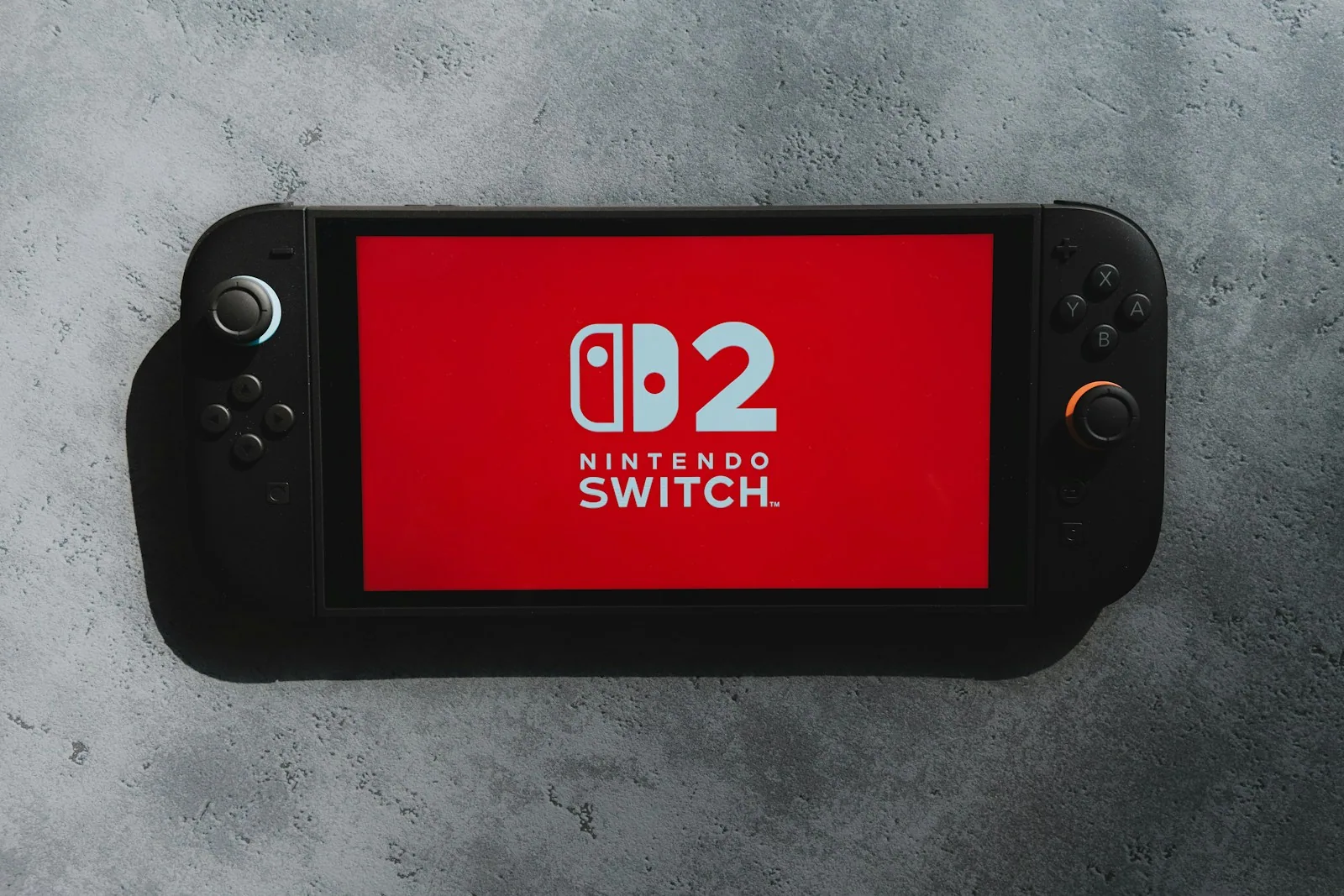
The Nintendo Switch 2 launched in June 2025 with the biggest console launch in Nintendo's history — 3.5 million units in four days — and brought a technical decision that seems to contradict the company's public stance: the console uses NVIDIA artificial intelligence, via DLSS technology, to render graphics in 4K, while Nintendo remains the only major publisher openly skeptical of generative AI in game development.
TL;DR
- Historic launch: 3.5 million units in 4 days, surpassed 10 million before Christmas 2025.
- Price: $449.99 standalone and $499.99 with Mario Kart World. In Brazil, it arrived above R$4,000.
- Hardware: Custom NVIDIA T239 chip, with DLSS and Ray Tracing. 7.9" 1080p HDR LCD screen, dock with 4K output.
- New features: Joy-Con 2 with magnetic attachment and mouse mode, GameChat with native voice and video.
- Compatibility: Most original Switch games run, many with visual improvements.
- AI stance: Nintendo remains publicly against generative AI in game content, even while using AI for upscaling.
The launch that rewrote Nintendo's own records
When the Nintendo Switch 2 launched on June 5, 2025, no one was prepared for the scale of the impact. In four days, the company shipped 3.5 million units — a number surpassing any console launch in industry history, including the PS4, Wii, and the original Switch itself. The predecessor, launched in 2017, had sold 2.7 million in an entire month.
Demand was so high that Nintendo had to ramp up production shortly after launch. In January 2026, during the quarterly results announcement, the company revealed that the Nintendo Switch 2 had surpassed 10 million units sold worldwide. For comparison, the PlayStation 5 took about eight months to reach the same number.
Why did it sell so much? The answer has three layers. First, eight years after the original Switch 1, the public was saturated with aging hardware — games like Tears of the Kingdom were already running at their limit. Second, Nintendo maintained one of the smartest moves in the industry: near-total backward compatibility. Anyone who bought a Switch 2 didn't lose their digital library. Third, and perhaps most importantly: Mario Kart World at launch. The company's most profitable franchise, now with an open world and up to 24 simultaneous players, was the classic system-seller.
Inside the hardware: NVIDIA T239, DLSS, and Ray Tracing
The technical leap of the Nintendo Switch 2 lies in a single chip: the NVIDIA T239, custom-designed for Nintendo, with Ampere architecture — the same family as the RTX 30 series GPUs for PC. It's a System-on-Chip combining an ARM Cortex-A78C CPU with a GPU of 1536 CUDA cores, and this is where the AI resides.
DLSS, short for Deep Learning Super Sampling, is NVIDIA's technology that uses trained neural networks to reconstruct images at higher resolution from frames rendered at lower resolution. In practical terms: the game is rendered internally at 1080p or 1440p, and the AI reconstructs the result in 4K with near-native quality. Without DLSS, running a modern game in 4K would require a very expensive GPU. With DLSS, the Nintendo Switch 2 delivers next-gen console visuals within the thermal envelope of a portable device weighing just over 500 grams.
Hardware Ray Tracing
The console also supports hardware Ray Tracing — another technology that relies on dedicated acceleration to run in real time. It's not the same level as the RTX 4090, of course: we're talking about an optimized version for mobility. But it's enough for realistic reflections in games like Metroid Prime 4 Beyond and enhanced global illumination in Donkey Kong Bananza.
Screen, storage, and battery
The 7.9-inch LCD screen with 1080p and HDR replaced the 720p display of the previous model. Storage capacity increased to 256 GB internal, with exclusive support for microSD Express cards — faster and more expensive. And the battery, despite the more powerful hardware, maintains between 2 and 6.5 hours, thanks to the energy efficiency of the Ampere architecture and DLSS's role in reducing rendering load.
The paradox: AI for rendering, AI not for creation
Here's the part that deserves attention. While the Nintendo Switch 2 embraces NVIDIA AI to solve hardware problems, Nintendo's public stance on generative AI in game development is the most conservative in the industry.
In interviews and during presentations to investors in 2024 and 2025, Shuntaro Furukawa, Nintendo's president, was asked about generative AI and responded with the same caution each time: the company monitors the technology, is attentive to intellectual property issues, but has no plans to use generative AI to create content for its games. This is a distinct stance from what we've seen at Microsoft (which signed a partnership with Inworld AI for NPCs), Sony (which patented AI systems for reactive characters), and Ubisoft (which adopted generative tools for narrative design).
The stated reason is legal-creative. Nintendo's characters — Mario, Zelda, Pokémon, Metroid — are the company's cultural heritage, with decades of international litigation defending every pixel. Training generative models based on this collection, or allowing AI-generated content into games, opens copyright loopholes that Nintendo simply does not want to open. And it goes further: the internal philosophy favors artisanal design. Every animation, every level, every interaction is polished through human iterations.
The contradiction is only apparent. DLSS is AI for technical use, not creative. The technology doesn't invent pixels from nothing — it uses trained neural networks to infer what an image would look like at higher resolution, based on data that already exists. No new content is being generated, only reconstruction. Nintendo uses AI to do what humans can't do (render in real time) and protects AI from what humans do best (create worlds).
For product teams thinking about adopting AI, this is a useful benchmark: not every use of AI carries the same ethical, legal, or strategic weight. The difference between using AI to accelerate technical pipelines and using AI to generate product content is the same difference between adopting a WhatsApp platform with unlimited agents and outsourcing all brand communication to a generic language model.
Joy-Con 2, GameChat, and the mouse mode no one expected
The Joy-Con 2 changed how the controller attaches to the console: instead of rails, a magnetic attachment with a lock-release button. It seems like a detail, but it dramatically reduces the mechanical wear that killed so many original Joy-Cons with stick drift. Nintendo learned — after class-action lawsuits in the United States and the European Union.
The surprise no one predicted was the mouse mode. Each Joy-Con 2, when placed on its side, works as an optical mouse, with a bottom sensor that tracks movement on a flat surface. The practical application: games like Civilization VII, Drag x Drive (wheelchair basketball sport), and Mario Party Jamboree use the mode for cursor precision that analog controls can't deliver. It's Nintendo opening new niches without complicating things for those who just want to play Mario.
GameChat is the third pillar. Console-side, with a built-in directional microphone in the top bar of the hardware, it allows voice chat with up to 12 players and — with the separately sold accessory camera — video chat within the session. It competes directly with Discord, but integrated into the console. For families and groups who play together remotely, it's finally a first-party feature that works without a parallel mobile app.
The releases that justify the upgrade
Hardware without software is a store display. The Nintendo Switch 2 launched with Mario Kart World as a bundle, and Nintendo staggered major releases in the following months:
- Mario Kart World (June 2025): continuous open world between tracks, 24 simultaneous players online, new Knockout Tour mode. Sold over 5 million copies in two months.
- Donkey Kong Bananza (July 2025): the first Donkey Kong game in 3D in 25 years, with a complete scene destruction system. Showed the hardware's potential for complex physics.
- Pokémon Legends Z-A (October 2025): simultaneous release on Switch 1 and Switch 2, with the Switch 2 version offering Ray Tracing and stable 60 fps.
- Metroid Prime 4 Beyond (December 2025): delayed since 2017, finally delivered. Takes advantage of Ray Tracing and DLSS for visuals that rival the PS5.
- Kirby Air Riders (announced for 2026): spiritual sequel to GameCube's Kirby Air Ride, directed by Masahiro Sakurai, creator of Super Smash Bros.
And there's also the Nintendo Switch Online + Expansion Pack initiative, which on Switch 2 gained a catalog of classic GameCube games — The Legend of Zelda: The Wind Waker, Super Mario Sunshine, and Soul Calibur II were the first three. It's Nintendo finally recognizing the GameCube as an official part of its retro lineage.
Comparison: Nintendo Switch 2 vs PS5 Pro vs Xbox Series X
For those deciding among the three console options in 2026, here's a quick and honest comparison:
| Feature | Nintendo Switch 2 | PS5 Pro | Xbox Series X |
|---|---|---|---|
| Launch price (US) | $449.99 | $699.99 | $499.99 |
| Portable mode | Yes | No | No |
| Dock resolution | 4K with DLSS | Native 4K | Native 4K |
| Ray Tracing | Yes (optimized) | Yes (advanced) | Yes (advanced) |
| Backward compatibility | Switch 1 (nearly total) | PS4 (total), PS3 (partial) | Entire Xbox history |
| Year 1 AAA exclusives | Mario Kart World, Metroid Prime 4 | Wolverine, Ghost of Yotei | Avowed, Indiana Jones |
| Paid online | $19.99/year basic, $49.99 premium | $79.99/year | $69.99/year |
The choice is not technically equivalent. Nintendo Switch 2 offers portability and Nintendo's exclusive catalog. PS5 Pro delivers raw power and a robust first-party library. Xbox bets on Game Pass and deep backward compatibility. Competitive gamers likely want PS5 or Xbox. Those who want Zelda, Mario, and Pokémon have no alternative: it's Switch 2.
Backward compatibility: what works and what doesn't
Nintendo promised near-total compatibility with the original Switch library, and in practice delivered around 95%. Some titles that relied on specific physical accessories — Ring Fit Adventure and the Labo line, for example — have limitations. But Tears of the Kingdom, Super Mario Odyssey, Splatoon 3, and the rest of the main catalog not only run but receive improvements in some cases: more stable framerates, shorter load times, and in select games, specific updates for Switch 2 with Ray Tracing and DLSS active.
Nintendo's policy here was smart: games purchased on the eShop automatically migrate to the new console via Nintendo Account at no additional cost. Those who had 50 games on Switch 1 opened the Switch 2 and continued exactly where they left off. It's a case study on how to avoid churn during hardware transition — the kind of lesson that applies to any SaaS platform when launching a new product generation.
It's worth noting a new feature: physical Switch 1 games continue to work when inserted into the Switch 2 slot. Nintendo kept the same proprietary cartridge format, avoiding Sony's mistake with the PS3-PS2 (which lost compatibility mid-cycle).
Is it worth buying the Nintendo Switch 2 in 2026?
It depends on three variables: budget, game priority, and portability scenario.
Buy it if you still have a Switch 1 and want to continue with Nintendo franchises on the best possible hardware; if you value playing away from home (plane, travel, sofa vs. occupied TV); or if Mario Kart World, Donkey Kong Bananza, or Metroid Prime 4 Beyond are on your wish list.
Wait if you already have a PS5 or Xbox Series X and your interest in Nintendo exclusives is lukewarm; if you're comfortable with the Switch 1 and haven't finished half its library; or if you live in Brazil and the local price (above R$4,000) is too steep — historically, Nintendo adjusts regional pricing 12 to 18 months after launch.
Don't buy if you want top-tier Ray Tracing for modded Cyberpunk 2077, exclusives like Spider-Man 2 or Forza Horizon, or if you've never been a Nintendo audience. The Switch 2 is excellent, but it doesn't replace a PS5 Pro or PC gaming for specific cases.
The adoption trajectory suggests we're at the beginning of a long cycle. If Nintendo maintains the release cadence it had with the Switch 1 (which got its Tears of the Kingdom six years after launch), the Switch 2 should remain relevant until 2031 or beyond. It's an investment with a long lifespan — something fewer and fewer tech hardware offers.
Conclusion: the paradox is the strategy
The Nintendo Switch 2 is not an AI console. It's a console that uses AI with surgical intent to solve technical problems — 4K rendering, energy efficiency — while keeping the creative heart in human hands. This distinction, between AI as a production tool and AI as a substitute for creation, is Nintendo's long-term bet. And it seems to be working: 10 million units sold in seven months is not luck.
For those working with product, software, or education, the Nintendo Switch 2 case offers a useful framework. Adopting new technology is not flipping an all-or-nothing switch. It's choosing where AI adds value — performance, automation, infrastructure — and where humans remain irreplaceable — vision, narrative, intellectual property. The same reasoning that applies to a gaming giant applies to any organization deciding what differentiates a custom application from a generic one: technology is a means, not an end.
Related posts
Manus AI: The Chinese Agent's 2026 Saga & Lessons for US Businesses
Acquisition blocked by Beijing, two days offline, and data deletion: what the Manus case teaches those who use AI agents.
What Counts as AI in 2026: A U.S. Legal Guide
Is your chatbot AI in the eyes of the law? Three U.S. regulations hinge on that answer—and most companies aren't ready.
Midjourney V8.2: AI Creatives for Ads in 2026
Draft mode, V8.2, commercial license, and the billion-dollar Hollywood lawsuit: the practical Midjourney map for ad creative production.